Philosophy

What the school refuses matters as much as what it builds.

No rewards for learning. No AI replacing human judgment. No speed worship. The deeper philosophy behind motivation, human formation, productive struggle, and AI boundaries.

Copper engraving: a child and a friendly robot walking hand in hand through an old European city
AI for learning. Humans for becoming.

The real difference

Not just taught by AI. Learning how to grow with AI.

A tutor that asks good questions is only half of Ainstein. The other half is agency: your child learns to direct AI, doubt it, and build with it, the working skill their generation will actually be measured on.

Direct it

The AI works for them

In the Studio, students give the orders: “Build me a practice game for the skill I keep missing.” “Quiz me where I’m weakest.” Framing the instruction well is the learning, and a mentor reviews what the AI produces before it counts.

Question it

AI literacy is a subject

Taught like math or English: when to trust a model, how to verify a claim, why confident answers can still be wrong, and what to do about it. Children who grow up interrogating AI don’t get fooled by it.

Create with it

Authorship stays theirs

The writing coach critiques a draft against a rubric, thesis, evidence, clarity, but never writes a sentence for them. The games they build get played by classmates. The work remains their own.

The removal test.

Every feature we build must pass one question: if the AI disappeared tomorrow, could your child still do the essential human work? If the answer is no, we redesign it.

And because honesty is a skill too: every week, students tag their own AI use, “AI helped me understand” or “I used AI to get answers.” That self-report goes into your weekly story, unedited.

Philosophy

Built on learning science. Not on engagement tricks.

No pointsNo badgesNo leaderboardsNo streaksNo rankings

Fifty years of motivation research say the same thing: rewards for learning kill the love of learning. So we refuse the entire casino. Children at Ainstein work for the only prize that lasts, the feeling of getting it.

The language matters too. Nothing here is ever “failed”, it’s not yet. Skills are “fragile” before they’re “durable.” Mistakes are treated as the expected, nameable steps of learning that they are. Struggle is met with kindness, then with a better strategy.

And one promise above all: the AI never grades your child, never judges your child, and never replaces the human who notices them. Every important decision, progress, reports, peer sessions, passes through a mentor’s hands.

Life competencies

Life skills are not extras. They are on the curriculum.

Knowing algebra but not how to budget, cook, apologize, read a contract, or run a project is not an education. Every Ainstein student works through twelve competency domains, offline, in real life, every year.

Proven, not attended.

None of these are lectures. Each competency names its real-world evidence: a budget actually kept, a formal email actually sent, a contract read and explained, a meal planned and cooked, a micro-project pitched. The work goes into the portfolio, and a mentor witnesses the demonstration before it counts.

A record that means something.

It looks like an achievements wall. It behaves like a transcript: every entry carries its proof and its date, nothing is awarded for just showing up, and your child can print their Life Skills Record right next to their academic one.

Why we don’t sell speed

The brain changes through effort. Not through ease. Not through pain.

Some schools now promise academics “done by lunch.” We think that’s the wrong finish line. The neuroscience is blunt: lasting learning is built in the moment of frustration followed by breakthrough. Easy learning fades. Hard learning stays.

Two ways to get it wrong, flip each card for how we do it right

Make difficulty pointless.

Memorize, regurgitate, repeat. Effort without meaning, the classroom’s oldest mistake.

Result: graduates who associate learning with suffering.

↻ How we do it right
How we do it right

Make the effort mean something.

Every hard moment is retrieval of something real: your child’s own weak spot, resurfacing at exactly the right delay. The payoff is visible, the skill goes durable and stays. And the child names where it matters in their life, because discovered value beats lectured value.

Result: effort that compounds, and a child who trusts it.

↻ Back

Remove all difficulty.

Optimize for speed, celebrate quick wins, smooth every bump away. Learning as a race to lunch.

Result: graduates who collapse at the first real obstacle.

↻ How we do it right
How we do it right

Calibrate the struggle.

New skill? Study a worked example first. Getting shaky? Support comes back. Getting strong? Support fades and the problems get real. The tutor gives the smallest hint that keeps your child moving, and struggle is met with kindness, then a better strategy.

Result: confidence that was earned, and holds.

↻ Back

The key word is productive. That’s the difficulty we keep, calibrated, kind, never pointless. We will never promise “faster.” We promise: it sticks.

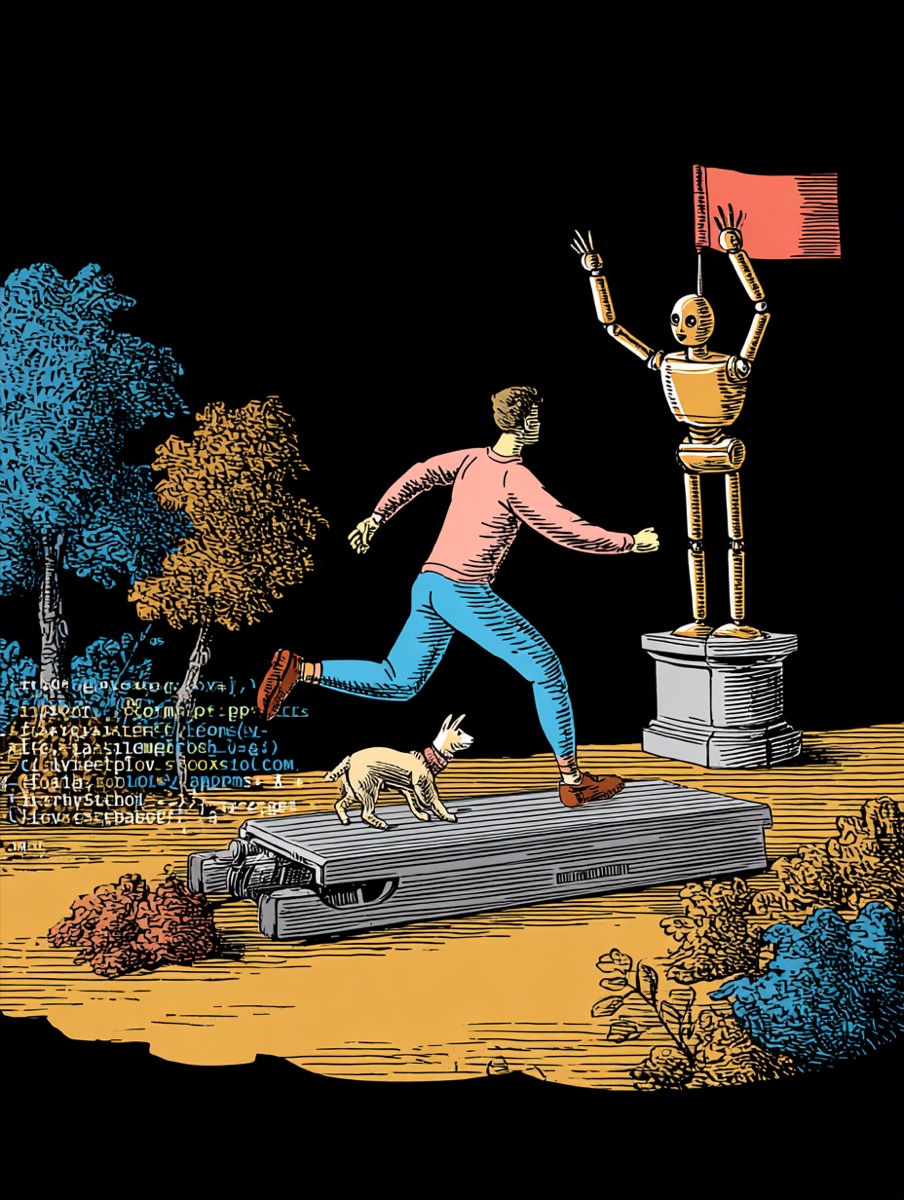
Copper engraving: a runner races on a treadmill toward a robot holding the finish flag
When speed is the goal, someone else holds the flag.

Strengths first

A century of report cards listed what children can’t do. We flipped it.

Your child is not a list of deficits. At Ainstein, the record that grows over the years is a record of capability, children learn early what their strengths are, what their interests can do for them, and how to use both.

The portfolio

Proof of what they can do

Not a grade average, a growing body of real work: things built, essays written, ideas defended out loud, projects finished. The question is never “where do you rank?” It’s “what can you do, and can you teach it?”

The mirror

Hidden strengths, surfaced

Each week, your child’s self-assessment is held against the actual evidence. When they’re better than they believe, and children often are, they hear it, with proof. Knowing your own strengths is a skill, and we teach it.

The expert seat

Every child gets to be the expert

Peer teaching runs two to four times a week in groups of five, and the teacher seat rotates through everyone. The child who just mastered fractions is the best teacher of fractions, and discovers what it feels like to be the one who knows.

Their wins

Victories, in their own words

At real breakthroughs, the moment is saved in your child’s own words, private, theirs. On hard days it’s offered back: you’ve done hard things before; here’s you, saying so. Confidence built on their own record, not on empty praise.

“Not yet” for what’s still growing. Proof for what’s already grown.

Founding families

Your child is not one size. Stop paying for fits-all.

A 20-minute conversation, no obligation. We’ll tell you honestly whether Ainstein fits your child, including when it doesn’t.

Copper engraving: a child and a friendly robot walking hand in hand through an old European city
AI for learning. Humans for becoming.