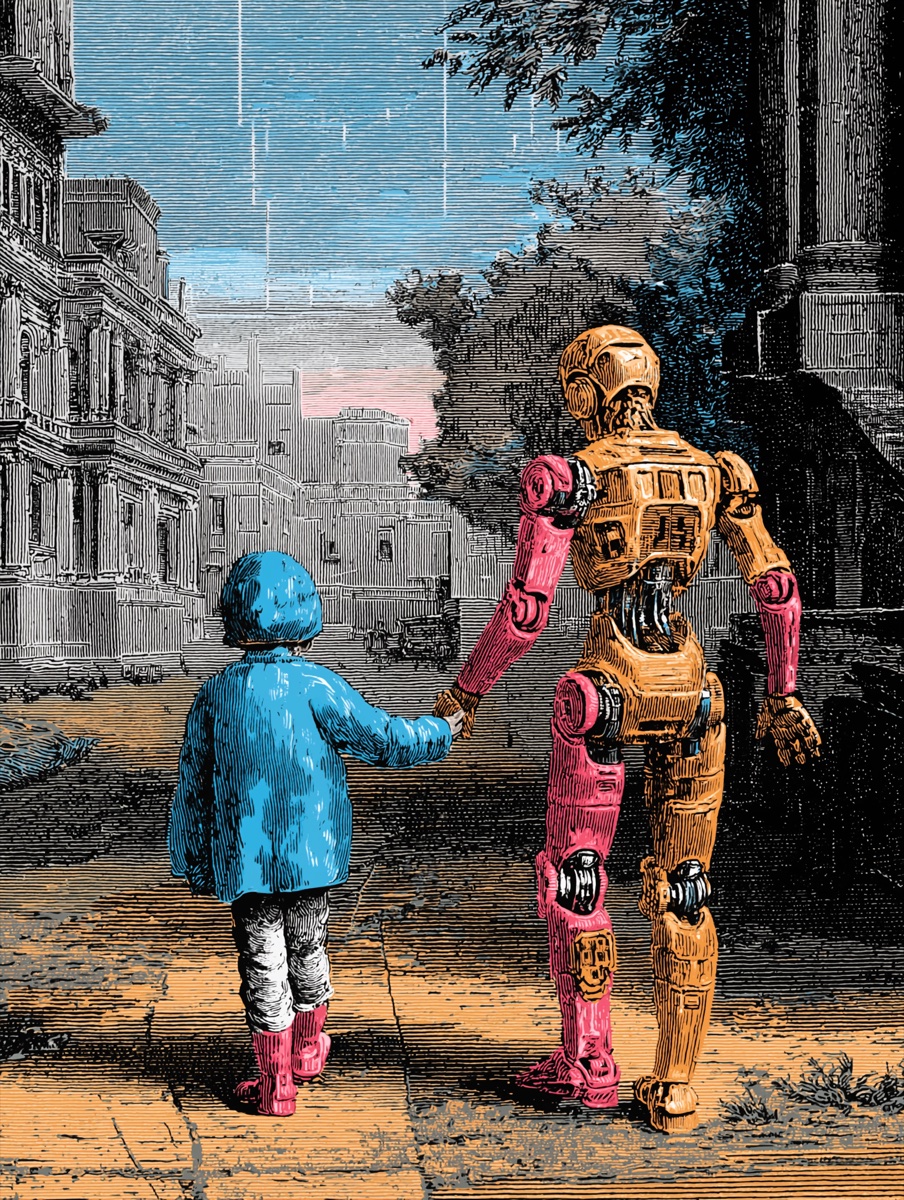
Personalized school for the AI age
Ainstein combines personal pacing, a Socratic AI tutor, and human mentors so children master the main subjects, learn how to use AI intelligently, and grow through real projects in online, campus, or partner school settings.
The problem
One teacher, one pace, thirty children. A child who misses one step in September is quietly lost by June, and nobody notices until the test.
It works, because one adult finally pays attention. But at €40–60 an hour, most families can afford one hour a week. The gaps grow faster than that.
Instant answers, zero understanding. The homework gets done; the child learns how to not learn.
Ainstein was built for one job: find the gaps before they become failures, then close them for good.
The learning model
The full method now has its own page. Here is the short version parents need first: Ainstein finds the real starting point, keeps practice active, brings weak skills back over time, and lets human mentors make the consequential decisions.
Placement follows actual mastery, not age, timetable, or yesterday’s grade.
The tutor asks for thinking first, gives the smallest useful hint, and keeps the work in your child’s hands.
Durable learning is checked through explanation, peer teaching, projects, and human review.
Examples
Not shortcuts. Not answer generation. Serious material transformed into better entry points, then brought back to the original text for real understanding.
Audio briefings, character maps, vocabulary, cultural context, workbook practice, and songs help students enter a medieval text before returning to the source.
A classical poem becomes several musical interpretations so students can hear mood, pressure, danger, and rhythm before analyzing the language.
What makes it school
Infinitely patient, available at 7 a.m. or 7 p.m., and it never forgets what your child learned last month, or what still needs another pass. It asks questions; it doesn’t hand out answers.
Not a call center. One mentor who follows your child over time, twenty minutes one-on-one every week, plus whenever your child asks. They celebrate real breakthroughs, catch quiet struggles, and stay accountable to you.
Small supervised groups, five students, twenty minutes, two to four times a week, where the child who just mastered something teaches the ones who haven’t yet. The fastest way to make knowledge stick, for all of them.
A weekly narrative written from real learning evidence, never from chat logs. What clicked, what’s still fragile, what happens next.
“This week Emma became proficient in two-step equations, but still makes sign errors when variables appear on both sides. She explained one-step equations to Tom in a peer session, teaching it back is how it sticks. Next week we focus on delayed retrieval and independent problem solving.”
AI literacy
AI is not the teacher replacing the human. It is a practice partner, a thinking tool, and a subject your child learns to command with judgment.
Students learn to ask better questions, build practice tools, and use AI to expose what they still do not understand.
They learn when to trust a model, how to verify a claim, and why confident answers can still be wrong.
The system can coach, critique, and generate practice, but the thinking, writing, explaining, and building stay with the child.
Rigor
Parents worry that “alternative” means “do whatever you want.” Ainstein is the opposite.
In a class of thirty, a child can disappear. Here, every weak concept is visible, not to punish, but to address.
You can memorize for a test and forget it. You cannot fake explaining a concept to another student.
Progress follows mastery, not the calendar. Nobody moves on while the foundation is cracked.
Ask your child “what did you learn today?”, they can show you. Real work, real evidence, every day.
Traditional schools produce grades. Ainstein produces understanding you can see: students who ask sharper questions, connect ideas across disciplines, and use AI without outsourcing their mind.
Ainstein students take MAP® Growth, the independent, nationally normed assessment used by millions of students across the United States. Same test, same norms, same standards.
Compare us. Honestly.
Ainstein can run online, on campus, or inside a partner school. You should still compare hard before trusting anyone with your child’s education, here is the honest map of the landscape.
| Classic online schools | The new AI schools | Ainstein | |
|---|---|---|---|
| The teaching | Recorded lessons, one pace for everyone | AI adapts the path, but the child stays a consumer of it | AI adapts the path, and the child learns to direct the AI itself |
| The pace | The calendar decides, ready or not | As fast as possible: “academics done by lunch” | As fast as it sticks, depth and durability set the pace |
| Motivation | Deadlines and grades | Points, streaks and prizes | Mastery itself, motivation is never bought with rewards |
| The human | One teacher, hundreds of students | Adults supervise the room | A named mentor follows your child and approves every consequential decision |
| Proof | Report cards | The company’s own dashboards | MAP national norms, an external test, plus weekly evidence you can read |
| Screens | Full school days on video calls | Fewer hours, but the app decides | Hard caps in the software: 20 min per subject, 2 h per day, life offline |
The credential
Because it doesn’t reduce school to one exam. Most systems, the Matura, the IB, A-levels, funnel years of learning toward a single centralized final, and every lesson quietly bends toward it. The American high-school architecture is different: credit-based, school-designed, reviewed by external accreditors. It’s the recognized credential structure flexible enough to hold mastery pacing, portfolios and life competencies, while keeping your child legible to universities worldwide.
Diploma, transcript and portfolio, plus SAT/ACT and AP courses in Years 11–12, when the target colleges ask for them.
Honestly: a US diploma alone is not a Matura. Austrian and German universities typically want the diploma plus about four AP exams, so students targeting Europe plan exactly those into Years 11–12.
For the child who builds a company, a craft, a body of work: the capstone, the portfolio and the Life Skills Record stand on their own, capability without a gatekeeper’s stamp.
Standardized finals are optional, and on purpose: a Year-12 sprint toward a door your child actually wants to walk through, never the water they swim in for twelve years.
Will university still be the gate in ten, fifteen, twenty years? We don’t know. Nobody does, and a school that claims to know is selling something.
The diploma is not the whole promise. Your child leaves with evidence of what they can build, the habit of asking better questions, and the range to connect disciplines when the next problem refuses to fit a box.
Programs
Same learning model, same mentors, same philosophy, delivered online, on campus, or inside a partner school.
The complete pathway: core subjects, human mentoring, AI-guided practice, projects, portfolio, and diploma planning.
Focused support for children who need to catch up, pull ahead, or close specific weak spots.
The full Ainstein model on campus at the Otto Wagner Areal, opening September 2027.
Bring the Ainstein learning engine into an existing school, with teachers in control.
Questions parents ask
The Full-Time School pathway follows a structured American high-school curriculum: recognizable courses, credits, transcript-compatible records and a graduation audit. We are building the US diploma pathway with accreditation partners; until that is finalized we say exactly that, and nothing more. On a parent call we’ll show you precisely where the pathway stands today.
Yes, with honest planning. A US high-school diploma alone is not treated as equivalent to the Matura or Abitur; Austrian universities typically want the diploma plus around four AP exams, and language requirements apply. So for students targeting Europe, we plan exactly those AP exams into Years 11 and 12. The pathway is well-trodden; it just has to be planned from enrollment, not discovered in the final year. We plan it with you.
The tutor can only act through a fixed set of approved tools; it cannot roam. Every message is safety-screened first; anything concerning stops the tutoring and alerts a human mentor immediately. The AI never decides your child’s progress, never writes to their record, and parent reports are composed from structured learning data only, never from chat logs.
There are no ads, and student data is never sold or used for advertising. Ever.
Yes, that’s the point. Mentors run the weekly check-ins, approve every report, verify real mastery in person, supervise all peer sessions and make every consequential decision. The AI handles repetition and patience; humans handle judgment and care.
Our tutor is Socratic by design: it asks for your child’s attempt before it helps, gives the smallest useful hint, and refuses to be an answer machine. And mastery is verified in ways that can’t be faked: explaining out loud, teaching a peer, retrieving after a delay. We even ask students weekly to reflect honestly on how they used AI, and that reflection goes to you.
Both are the same case to us: the plan follows the child. We place by actual mastery, not birth year. A child with gaps works exactly at the edge of what they know; an advanced child moves on the moment mastery is proven, not when the calendar allows.
Through structured, supervised togetherness, and a lot of it. A normal week has two Socratic rounds and two to four peer-teaching sessions in a fixed group of five, plus group projects and cohort rituals: the same faces, week after week, which is how children actually form friendships. Younger children get more peer teaching and shorter seminars; teens get the full discussion dose. Every session is mentor-approved and takes place in a supervised space; there is no unsupervised open chat, by design.
Three ways, and none of them require trusting us. First, MAP® Growth: the independent, nationally normed test used across US schools, taken two to three times a year, showing your child’s percentile and growth against millions of American students from a test provider we don’t control. Second, weekly evidence you can read: what was practiced, retrieved after a delay, taught to a peer, defended out loud. Third, ask your child to explain something they learned; with mastery-based learning, they can.
We share their core belief: AI personalization works, and children can master academics in far less time than a classroom takes. We part ways on four principles. First, speed is not the prize: “academics done by lunch” optimizes clock time; we optimize what lasts. The brain keeps what it works for, so we set the pace by depth and durability, not by the clock. Second, your child shouldn’t just be taught by AI; they should learn to command it; AI literacy and the Studio put the AI in your child’s hands. Third, we never buy motivation: no points, prizes, streaks or leaderboards; fifty years of research say rewards corrode the love of learning. Fourth, every consequential decision is made by a named human mentor, not an algorithm.
And we invite the same external yardstick, MAP national norms, so you can compare outcomes, not marketing.
Learning Support is designed to cost less per month than a single weekly hour of private tutoring. Full-Time School founding-family terms are shared on the parent call; we keep pricing conversations human because every family’s situation is different.
A weekly story in plain language: what your child worked on, what became solid, what’s still fragile, what they taught someone else, and what the mentor recommends next. Plus mastery progress you can read at a glance, and a one-click export of your child’s complete learning record, any time. It’s your data.
Founding families
A 20-minute conversation, no obligation. We’ll tell you honestly whether Ainstein fits your child, including when it doesn’t.